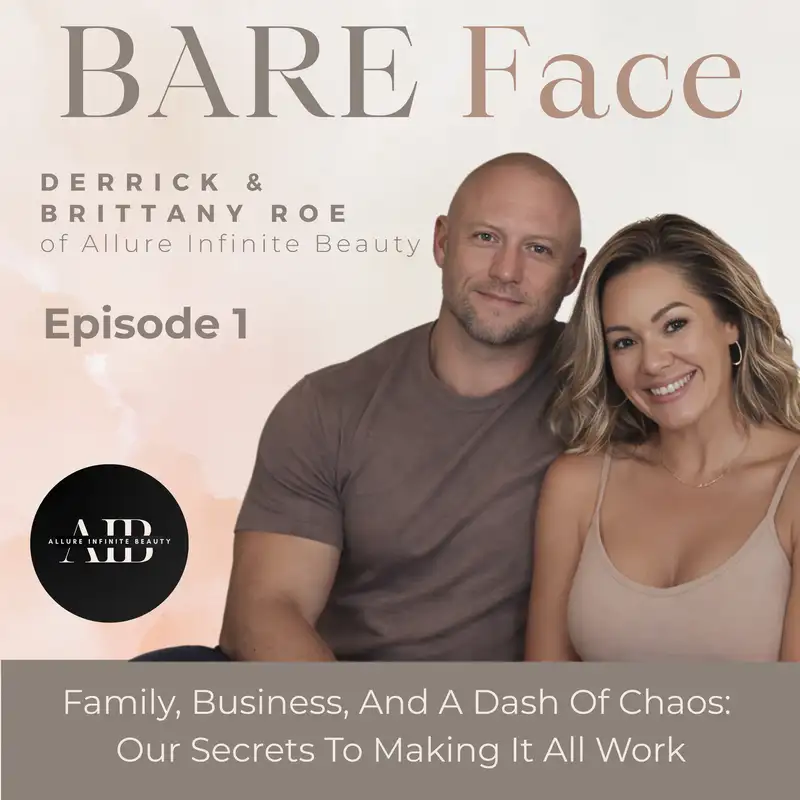
Episode 1: Family, Business, And A Dash Of Chaos: Our Secrets To Making It All Work
It's supposed to be challenging. It's supposed to be hard. You're building the airplane as you're jumping off the cliff. It's supposed to be a non-work-life balance. We're very aware that our industry from the outside looking in can sound intimidating and scary. Welcome to Bare Face Podcast. I'm Derek.
I'm with my wife, Brittany, and we're business owners, partners in life, and parents building a company in the aesthetic industry while raising a family and trying to stay married in the process. This podcast is where aesthetics meets real life. We'll talk about what actually goes on behind the scenes of this industry, what clients should know before sitting in a chair, and what really takes to grow a business without losing your values, your marriage, or yourself in the process. Whether you're here because you love aesthetics, you're building something of your own, or you're just curious about how we make all this work. What if I do it, and it doesn't work? Is it painful? Yeah, and I think that's what most people want.
We are Brittany and Derek with our very first episode of Bare Faced Podcast. We are the owners of Allure Infinite Beauty, and we want to talk about who we are outside of the treatment room a little bit. So we have kind of a unique story. We're both husband and wife, business owner, operator, technician, raising three kids, pure chaos all the time. Pure chaos, but we're just winging it. So we're going to figure this out. Bare Faced is the name of the podcast.
I don't know if we're going to keep it or roll with it. I like it. So Bare Faced to me just kind of means we're going to be raw. We're going to be bare with being business owners, our married life, raising kids, the things that we've learned in the industry, the do's and the don'ts, not getting kind of caught up in the fakeness.
Yeah, there's a lot of that.
We just want it to be kind of chill and show more of the real side of not just this industry, but what it's like to be kind of an entrepreneur in any industry, but also raising a family and trying to keep the marriage together and just molding all of that as well as you can and kind of what to expect and understand what it's all about. I think a huge misconception that we had going into business together in the beginning was this thing that everybody talks about, which is your work-life balance. And so I think for a long time we strived to have a work-life balance, but that is not a thing when you own a business that you are very much hands-on in. So a few things that we have done as a family, I guess, to kind of make things work for us, you know, boundaries that we've created within our own lives, our employees, personally, just how we work together all the time. I get clients ask me all the time, how do you guys work together? How do you do it?
Yeah. So creating time away from each other, but also obviously focusing on family. And that has always been our biggest, what? I don't want to say challenge. It is a challenge. It's a huge challenge. You just have, you know, our expectations is a big part of it.
So we'll get into the chaos of it all later, but the challenges that you face in business, you don't realize they're almost the same challenges you face at home and you're almost treating your home life like your business life. And once you realize the expectations of things, it becomes a little easier. Like it's supposed to be challenging.
It's supposed to be hard. It's supposed to be a non-work-life balance. It's almost like work-life is more of a seasonal piece instead of a daily piece. Instead of looking at it like, well, I did this many hours. Now my life starts after this hour. And then I go to bed and we do it again. That's a more of a daily balance.
But I think in what we do, it's, you have to be good with seasonal balance, almost like zooming out and looking at it over the course of a year instead of every day. And it's hard. I mean, people, people have a hard time seeing past next month or past their next paycheck, or it's very short-term thinking. I think that's what gets us past a lot of that is saying, well, we're going to, we're going to work kind of like a sprint and recover. We're going to work, work, work. And then also at the same time, you're on the dinner table and they chime in. Some of them don't.
Well, some of them, we have three kids. I don't have like a whole gaggle of them, but one of them really wants to know what's going on. So he'll stick around and give us advice. You're like, yeah, no, you should definitely get rid of that person. I'm like, no, it's not what we said. Yeah. He has a lot of strong opinions about business, which is great, you know?
And it's kind of rubbed off on him to where he, he got a little, I don't know what that's called. It's like a little trailer for your bike. It's like a rickshaw, I think, thing. Put a, put a cooler in it and he put some drinks in it and he'd ride to the park and, and sell drinks. And so we put together a spreadsheet for him to say, well, this is what my product costs and this is what I'm selling it for. And here's my profit. And now I can buy more product.
And. He's very strategic about making money and making sure that. So he has, he's 14 and he has like three different side jobs, things that he does. But I think it's really important. You and I both came from a family business background. So that part was not a shock. I think for either one of us, like when we became business owners, we knew what we were getting into as far as work and hustle.
And I remember my mom actually coming to us in the very beginning, like, are you sure you're ready for this? And, you know, kind of gave us advice. And, um, I think that's been really positive for both of us to have family who truly understands. I hear a lot in different circles or business podcasts or different things like that of, you know, um, when are you going to get a real job? When are you going to, I don't know, what are you doing with the silly little business of yours or, you know, the negative comments that people like to make about your decision in business. I don't feel, unless you've had this experience, I don't feel that we've ever had that, um, from anybody who's close to us. We have a lot of cheerleaders.
We have a lot of people who support us and watch out for our, what's the word I want to use, our best interest in heart. So we have a lot of support, which has helped immensely in balancing it all. Oh, no, that's true. I think I think that I've heard that more from a couple of clients over the years, but when it comes to that, yeah, you hear that a lot is that they're all the real job thing. I actually heard that while I had a job because I was doing this, I was in corporate and I was doing this at the same time. And so I actually did hear a lot of that from where I was working in like the career and they wanted me to continue to advance and they wanted me to continue to do what I was doing there, but and kind of stop the side thing. Like, it's fine.
You don't like, you should really pour into this. And so give everybody a little bit of a background.
Um, so what, what was your perception of business when you were, let's say our kids this age, growing up, watching your parents in business, or did they keep it separate enough or you were just. They were gone all the time, doing your own thing and not paying attention all the time. But, um, you know, my dad went through the same thing. So he, well, to preempt that, like, yes, they had the business prior. We stepped in much later in the business and, and basically purchased it from them to take over and grow it. So we still have a lot of stake in the game, but I mean, prior to that, um, it was watching my dad actually had two jobs. So he would work at night and then he would work during the day and he would sleep in between both of those cycles.
Uh, he would, uh, he was an x-ray tech and then he would come back and he would do the career, you know, kind of his what he, this is what I'm going to grow. And just in a little back room in a salon studio. So we had one little tiny room and then it kind of expanded from there over or many, many years, I think, what was the question?
How did that shape you? Do you feel that you were prepared getting into business? Did that affect how you, you thought about work? Um, like I know what my answer would be for myself, but when you were at that decision-making time where it's like, okay, I can advance in corporate, or we're going to make this leap into business ownership, entrepreneurial path. Do you feel that you were prepared for that by being exposed to it as a kid? No, not at all.
Not even a little bit. Um, cause I, they never talked to me about it. They never talked to me about business. They never talked to me about anything that they were going through. I had no idea when I was a kid, none whatsoever. It just seemed like everything was going really well. So back when I was living in Cambodia, no, like everything was just going well.
And I didn't know it. I mean, there were a lot of times when they were completely out of sorts, completely, I mean, almost bankrupt. It was the same thing that all most small business owners deal with. It's just that they weren't bringing it home or I wasn't being aware enough. And so they would, they would kind of keep that there and then keep the family piece different. But they also, when I was young, so when I was about 16, they gave me the first book they got me was the seven habits of highly effective teens. And that's when it started for me just to go all in on, okay, well now I need another book and another book and another book.
And it almost like this discovery journey of, you know, from rich dad, poor dad and on and on of entrepreneurship. Well, I didn't realize that that didn't correlate directly to just having a job. So I went into jobs. I had a ton of them. I think I had 21 jobs by the time I was 21. And so it was me learning more so that I couldn't have it. I couldn't be in a career. And so going through that, going through some other startups, and then really coming down to, Hey, none of this is working.
And I don't know why, and we're having kids. So I needed to go into a career that was more stable. So that's where I went into a 12 year corporate career prior to all of this, which is probably for the best, because that's where I learned management in so many aspects and sales, communication, just how to solve problems and how to be a valuable part of the companies. So I can take that now and I can move it towards what we're doing here. So I say prepared wise, I think that career prepared me a little bit, but nothing prepares you for when you actually go all in. There's not a single thing that can prepare you for what you're going to run into and then how it's going to affect your life at home. How it's going to affect your kids, how it's going to affect your marriage, and then trying to simultaneously piece it all together.
There's a saying, Live life in between. Live life. Well, try to.
Yeah. Your life kind of becomes work, but just saying of like you're building, you're building the airplane as you're jumping off the cliff. That's exactly the analogy because you're, Or at least the way we did it. I don't know. It's how everyone does it. Yeah. It's never easy.
It's never cut and dry. It's never one plus one equals two ever. It's always every day dealing, not dealing, but just you're solving problems. And so I think that's when I was talking about expectations, we have the expectations at home with our kids. We have the expectations with our marriage. We have expectations in the business expectations all around and being okay with understanding that it's expected to be hard. It's expected that our marriage is going to go through ebbs and flows.
It's expected that we're not going to see our kids sometimes. And as long as you can expect that that's normal, part of the beginning stages, at least of owning a business, then it makes it a little better because you know, Hey, this isn't actually falling apart. It's just part of the process. So you have just a different view and a different way to solve those challenges.
Yeah. For me, obviously being raised in a family owned business as well. I was more hesitant to get into business ownership while the boys were little. I've worked for Allure for 22 years, probably. Is that right?
23? I don't know. It's been a while. A better half of my adult life. So that was kind of always a goal of mine was to kind of one day kind of take over or do something in that. I knew that I loved aesthetics and that's always been my passion pretty much right out of high school. But I knew that the beast of being a business owner was something totally different.
Watching my family go through it. I would say most of my family is actually entrepreneurs. So I was very much immersed into it. I, to the point of where I was like, Oh, I don't know if this is something that I want to do right now when the boys were little, but obviously. It just life kind of rolls and happens sometimes, but we've had such great support that I don't feel that we sacrificed, you know, their youth during this time. And hopefully they hopefully get something positive out of it. And they, you know, they have work ethic and they understand if you want big things in life, you have to work for it and it's just not handed to you.
So that's my, my goal, I guess, uh, maybe why we be openly share too much about the business, um, with them. So they have some real life expectations moving forward.
Yeah. It's just different. Um, like when you get into, I never watched my parents go to work, if that makes sense. Like they didn't go clock in, they didn't have like a nine to five come home. And then that was just it. They were home. That never happened.
It was always, they were working on something or they were doing two things at once. Um, again, I didn't really notice much when I was growing up, but it was also just your life. And so it was just was, it wasn't odd, but being in the career for so long, I mean, I have a hundred percent understanding of the matrix that kind of veil that you cross over from employee to owner. And it is a, it is, I call it the matrix all the time because you can't unthink or unknow what, you know, it's like that red pill, blue pill, and you can't, cannot, you didn't see the matrix.
Sorry. What are we even talking about? I don't know. I got the concept. I got watching it.
Okay. No, you can't, like, you can't go back and unlearn or unknow again, what you, what you kind of crossed over into because you start learning things. Like when you were an employee, you told me this when you were working in aesthetics and you had thoughts of like, oh, well let's do, we should do this and we should bring this on and we should, you know, um, you know, are getting paid more, just all these little tiny things that you think of as an employee versus then when you own, you're like, oh, that makes sense. Like I have to bring the value in order to get paid more or, you know, bringing on new things costs money and money that you don't know where it's coming from. It may not be in the budget. And so decision-making is a lot different and you have to understand if it's especially an owner operator situation that they're stressed out all the time.
Right. And there's only so much capacity for some people at certain times. So kind of understanding, I think, um, I can see it from both aspects, of course, like being an employee, um, and always wanting more, obviously at somebody else's expense. Like I just wanted to play with new devices or bring on new treatments and this would be fun. Um, I wasn't the one that had to worry about like purchasing the equipment, marketing the equipment, the insurance, the repairs. The, what if nobody wants this treatment, you know, that kind of stuff. How are you going to get new clients in the door?
Yeah. I don't know. I just, I just do the treatments.
So it's different. And I started back in the day before social media. So things were a little bit, so old, so old. So yeah, that was, um, it's definitely been an eyeopening experience. Um, and I have enjoyed it. We've definitely grown as people. Um, I think it's changed how we parent.
I know me specifically, I have an issue with an employee. I'm like going home and telling the boys like, don't you ever do this? Don't you ever say that? Don't you know, like, and kind of take it out on them a little bit. Um, and they're probably like, heck, she even talking about, but. Well, I have no context, but we go, like I did an interview either day and I'll go home and I'll be like, listen, cause I have, we have 17 year old, a 14 year old and a 10 year old boys. And so I'll go home to 17 year old immediately and be like, okay, let's talk about interviews real quick.
You know, this is how you're going to interview. This is what you're not going to say. Um, and you interview a ton of people, especially in that generation. It's like, okay, there's some things that need to be tweaked and I need to make sure he knows that. Yeah. And so that's another reason they know when we come home, it's like, oh man. Yeah.
They're always getting a lesson, a lesson they never asked for. Sure. Um, can we pause? Where do you feel like we should go from here? Like, that's kind of a little bit about how we maybe got started, but I was still, if I started the podcast, what were, what your, yeah. What the audience expects from you guys.
Okay. Okay.
So the reason we wanted to start a podcast, we hear all the time, I don't know how you guys do it. How do you balance it all? Um, what's next? And I think that we are perceived a certain way online or even clients perceive us a certain way, obviously in a treatment room or, you know, our employees, that kind of stuff. I feel that we're very open and transparent about everything. We're too much, maybe too much. Um, but I feel that that was, you know, when we were deciding what's the topic of the podcast, do we want this to be educational to guests about certain services?
Um, do we want it to be business focused on the things that we've learned? Um, but our lives are so intertwined into our business and that's what we really want to focus on with this podcast is just kind of getting to know us, how we make this work, uh, the things that we've learned. And then obviously we have a, a huge passion for the industry as well. There's more than just doing treatments or, you know, doing a chemical peel on somebody, whatever, um, we truly love helping people. And if that's helping them with their skin concerns, if that's growing employees and helping them either onto the next level of what it is they want to do in their career or trainings, um, we're kind of the mom and dad of the office, so we've lots and lots of times, um, just sat down with individual employees and talked about life and kind of give life experience far beyond maybe the professional way of handling those conversations, but that's kind of the embodiment of.
Yeah. So just that we're normal people. Um, we think we're normal people. People don't think we're normal people, but like the comments of how do you guys all hold it together? How do you do it? We're so proud of you for, you know, the getting through all the chaos that you get through and how amazingly successful you are and we're like, we talking to, you know, cause it's, it's, it's, it's much, much deeper than that. And so, and I think any, anyone that has a business, whether you're in this industry or not, doesn't you're, you're feeling the same thing.
Uh, it's, it's just a constant, constant, constant struggle, but it's a good struggle. That's how you grow. That's how you learn. And I think going forward in the podcast, a big part of what we wanted to do was talk about the treatments, like you said, dive into some more of the technical aspect, but also just how it can benefit a client as opposed to the major science behind it, you know, how the laser works instead of saying, Hey, here's what we can do. We're very aware that our industry from the outside looking in can sound intimidating and scary and expensive. And what if I do it and it doesn't work or is it painful? Um, I've done treatments in the past, you know, somewhere else.
I didn't get the results I was looking for, you know, kind of all of, all of that can be overwhelming. That's kind of what we hear in consultations all the time. Um, and so kind of taking it back a little bit and explaining treatments, but more so when we're doing consultations, we're not really doing any treatments that other people aren't doing. It's not like we've had this, you know, secret treatment that only Allure offers. Um, but I think it's how we educate our guests and relate to them as people. And that's kind of what we wanted to bring to the podcast as well.
Yeah. And I think that's what most people want. They want to be treated like people. So they're not a number they're a, Hey, here's your issue. Here's how we can solve that for you. So there's no hard selling. It's just, there's a lot of things people don't know are possible.
A lot of people just go straight towards, you know, Hey, I need surgery for this. And obviously while I, you know, a lot of people are just like, I don't want to take that route, the risk, the, the money, uh, they don't understand that there's actually this huge opening now of the advancement in lasers and advancement in skincare, anti-aging from peptides to the GLP ones, the trizepatides that are just are massively changing what people perceive as saying, Hey, I need surgery. And that's the only solution to my problem.
Right. When even now surgeons are favoring towards lasers as kind of a gap treatment. So when they just, Hey, you don't need full out facelift, but what we can do. Some people do.
And that's fair. Yeah. But you still have to maintain it. You address the health of the skin. Yeah. And I think that's where this, this part of the industry is new. And we've been doing it so long.
It's not new to us, but when I talk to people outside of the industry, they don't even know what a laser does. And that's to me, that's like crazy, but it's just what we've learned forever. So there's the ability to fix or do a lot of anti-aging that actually improves the health of the skin while it's anti-aging. And there's so much more to the treatments that we do. Obviously everybody came through the door. There was a why that brought them in. I, you know, their son's getting married or they just got divorced.
We hear this one a lot. Like I just got divorced and it's now it's time for me to focus on me or the baby just graduated college and empty nesters and they're wanting to focus on the things that they've never focused on before because they didn't have the time, they were raising families or just, yeah, they're aging. And we hear this all the time. I looked in the mirror one day and I don't know who's looking back. Like I still feel young, but my inside self doesn't reflect what's in the mirror. And so people just wanting to feel their best. I think we've gotten away from the overdone aesthetics where people look fake. We heard that all the time.
Like, I don't want to look like, you know, fill in the blank, a celebrity. They want to look like themselves. They want to go to that high school reunion and people be like, oh my gosh, she looks so good. Like she looks healthy. She's glowing. And I love being a part of that journey for people. I think that that's my favorite, just helping them achieve that goal.
Yeah. I would say a big one I get is, is the dating pool. Did you say that? Getting divorced and then getting divorced and trying to date at, I mean, I have, you know, 40, 50, 60 plus year olds that are trying to get back into dating and that's when they usually are like, okay, yeah. What do I got to do? So, which sounds awful by the way.
Awful. But so I tell them, I'm like, first fix your personality and then no, no, no, it's, it's, but it's a, it's those stages of life. There's always a reason to come back in. Sadly, it is the piece where it's, it's, well, now I'm going to take care of me because for the last 20 some years I haven't. And so we get a ton of that too. Which is very normal. I could put myself in that category too.
We could always do better taking care of ourselves. Yeah. Always. Always. What's, um, like with the business, what do you think is different from the beginning to now to where what you've learned more in an aspect of the business, the family, the marriage, and all of it together, what you thought versus what it is now to kind of operating it all? Making it all work. Well, of course, year over year, the things that used to be this huge learning curve are now just second nature.
So some of the things we used to have meetings about or spend our weekends trying to figure out are now just like kind of silly that they were even conversations. So I guess you just gain confidence, obviously the more you do things. Um, I think that that's been huge, but for me, especially within the last few years is just making sure that I shut it off sometimes. Like if I, whatever it is, Sunday, that's something that we kind of hold sacred for our family. That's our time together. We're going to church. Um, there are rare exceptions, of course, that we have to go into the office.
We do have to go do work, but it is something that we try to make, um, a really big point that we're home, even if we're not doing anything that's time spent together. Because, as everybody knows, your kids grow so fast, and that time is gone, um. and truly work will always be there waiting for you. You could finish 20 tasks; you still have 20 more to go. so you might as well pause for a minute, um, take some time, because burnout is real, um, in all aspects of life. Obviously, you can become too consumed by anything. Um, I think I became a better leader, a better parent, hopefully a better wife in those moments of just, like, stopping for a minute, disconnecting, um, and kind of gaining perspective, um, during the downtime. So, I would say that that's been a big change for me. where in the beginning, we were there seven days a week. our kids were either with us or at home alone, um, and all it did was build resentment towards a lot of things in our life. so it was not helpful. And I think that's where it comes down to the expectation of not knowing that that stuff was supposed to be hard. it felt like it was bad, like, it felt like we were doing something wrong in the beginning.
And then, when you get to a point where it's like, oh, it's just every day is like this, and we just have to solve problems, it's like a mental shift of, I guess I'm answering the same question. is it seemed like what we were doing wasn't producing the result we thought it should in the time frame we thought it should produce it? and well, why is the home life suffering? This is bad, you know. this is, we're doing something wrong, and more it's just a paradigm shift of, it's hard. you're going to go through this; you just have to figure out how to make it work. and doing things differently, like getting your kids involved in the business a little bit, or having them come down and help with some of the stuff at the office, whether it's, or at the spa, more just fixing stuff, or cleaning, or whatever it is. having them just involved in some of it, or sitting down at the table and then asking questions that kind of spark their interest in business. and They were a huge, they were involved a lot in our new location. from the very beginning, we were so excited to kind of show them that empty shell of what it was that we first signed the lease on to today. and they were good and bad, a big part of that, like getting things set up at the very end. I mean, my ten-year-old was screwing on one of those outlet covers, and Jaden was trying to learn how to put on doorknobs. and they were, with a scaffolding, putting up the ceiling tiles. and you know, at the end of the day, they were like, begging to go back to school and to not do manual labor anymore. but and they were like, we did this, and that was really cool. and it's fun that they're a part of that too, because it is a family business. I mean, we we talk about that all the time. we are family owned and operated, back from the very beginning, when your parents started the company. so that's huge. we want our, we want our employees to feel like our family and friends. even though that, obviously, we've learned how to kind of navigate that a little bit better. but but also we want our guests to feel that way also. we want everybody to feel comfortable. we understand it's a, you know, you're bringing in your biggest insecurities to talk to a stranger about. whether it be, you know, your skin care, or your weight loss journey, or you have facial hair that you want lasered off. and you're embarrassed about that because you started taking testosterone, and now you have facial hair. like nobody wants to talk about their flaws. and so, we want them to feel really comfortable in our space. and that's something that we have always, I don't know, bragged about, I guess, for ourselves, is that we make people feel comfortable, or we try to. obviously do we always do that? Probably not, but it is top of mind.
No, that's what we want. That's something we talk about a lot with our team. That's what we wanted in the beginning, too, was when we, when we took over, we bought the business. and we wanted to expand it into more of a medical spa, as opposed to just a, kind of a spa. from there, we wanted to make it and keep it always as, like, a cozy environment, homey, family-oriented type, to where you could have. it wasn't just kind of trying to cater to the ultra-luxurious; it was more to cater to the busy career woman, you know, the realtors, the busy moms. that they have, they have, block out half a day; that's all they got, you know. and we were able to have them come in and enjoy and have a good experience with several different treatments. and then they were done, and they could go back to their lives, but still have a great experience. we could catch up with them, remembering, you know, having these conversations and feeling like they're friends. because we have had them as clients since their kids were little, and now their kids are our age. and going through all of that, that's kind of what we wanted to be in the beginning, and that's what we think we've been able to stay true to. Yeah, so we also, I mean, we went through, so we went through a lot of challenges over this last year, big time. and I mean, maybe it's a story for, we'll throw that into our next episode. but it's going from our old location that we had been at forever, and then that location being sold, and us having to move into something new. and we went through... It was a really long year. I mean, from really, like, signing the lease to contractor issues, but also just, like, the vision of how we wanted it all to work, too. I mean, there's a lot more. we had no idea. if you would have told last January me where we'd be today.
I think if you had an idea, you wouldn't have gone through it, because it was an extreme challenge. and going through, like you said, contractors, and permits, and leases, and then kind of learning as you went on some of it. to where we can, we would definitely now, if we had to do it again, we could navigate it pretty well. so but I think the challenges of that are, we could talk on that forever. so but we'll probably throw that into our next episode, so. It was pure chaos. Pure chaos. And that's what we want to do. I think going into the next few of these, definitely, you know, something to come back to is, we're going to get real, even more real. this was kind of an introduction into what we, the very surface level of how we navigate a lot of these things. and so, I think us just getting more real as we go, getting a little deeper into this, and even answering some questions, if there's any, like, guest questions, bringing people on. if you all have any questions, just, we want to know the deeper levels. we want to know the bad, or we want to be able to answer those questions too. talk about, hey, this isn't all just butterflies and rainbows, and it's not all great all the time. in fact, it's great very little of the time, and we want to talk about that, because people don't. and they think that those journeys are just, oh, well, business is business, and navigating business. well then you have a family. and so, there's a lot of people online, especially other podcasters and these Instagram videos you watch of these ultra successful people, entrepreneurs. and then there's some things that you just can't relate to. there's like, well, they're totally single, they've never had kids, they, you know, grew up with money, whatever the case is. it's like, we have all of these things really, not against us, but just, we have more challenges. and I think that that relates more to people that are like, well, how do I do this with kids? how do I do this, you know, when I'm taking care of this person? or how do I do this when everyone else is against me?
am I, whatever it is. so we want to be able to dive into those much deeper, and even answer your questions. Yeah, and I, obviously, sprinkling in all of the education that we have picked up over the years. not obviously, not just in business and parenting, because we're not, we're not new in that. we have a senior this year, so we've learned a few things over the years. but also just how to, you know, guide anybody if they're looking into getting aesthetic treatments, answering questions about that as well. our personal experience with receiving treatments and performing treatments, our favorite treatments. Yeah, and right now, I mean, it must have aired on TV somewhere, but CO2 resurfacing, CO2 cool peels, those are pretty hot right now. and so, I think we'll want to dive into some of those shortly, is talking about- Those are our favorite treatments. By far. but diving into just what they do, how they work, and then how they relate to you, or really relate to anyone, from a light to a, you know, deeper treatments. And who can get treated, I think that that's something we hear about a lot. there are so many misconceptions, especially if somebody has, let's say, darker skin tones. oh I can't get that done, I have dark skin. it's like, okay, we want to debunk some of the myths. Stay offline, stop searching for treatments, stop trying to figure it out on your own, because the amount of- Dr. Google doesn't always know everything.
The amount of misinformation is staggering, and I'll have people come in with their own aftercare, and I'm like, where did you hear this? Oh, well- Some guy on TikTok said- Right. So we'll dive into those, though. we'll try to give as much information- We're here to share it all, we're open books, we always have been. but I guess now we're going to do it on a bigger platform, so we're excited to share our life.
Yep. Thanks for spending time with us today. make sure to check us out on social media, check out our website, and we can't wait to see you again for our next episode